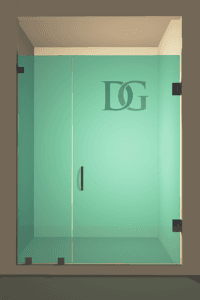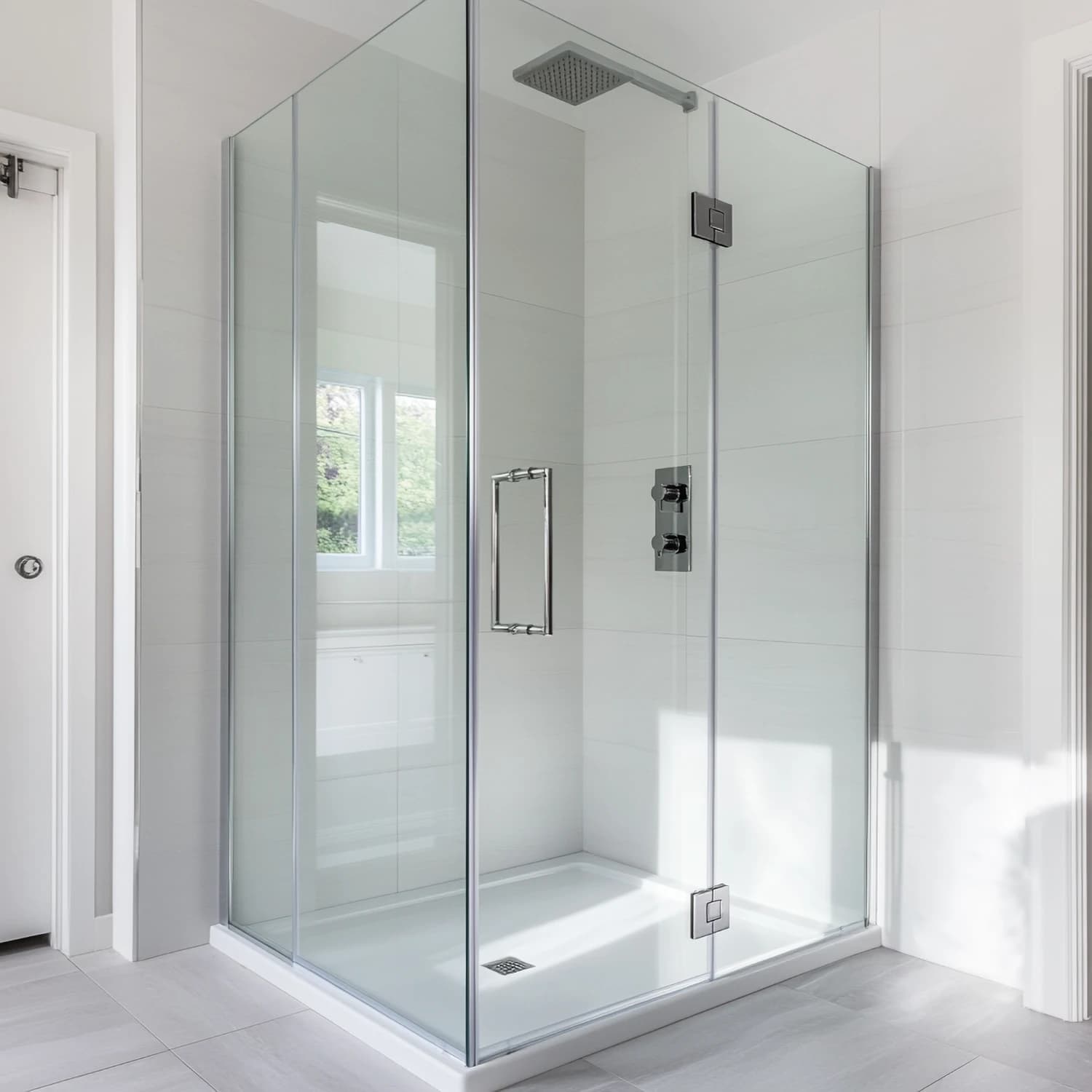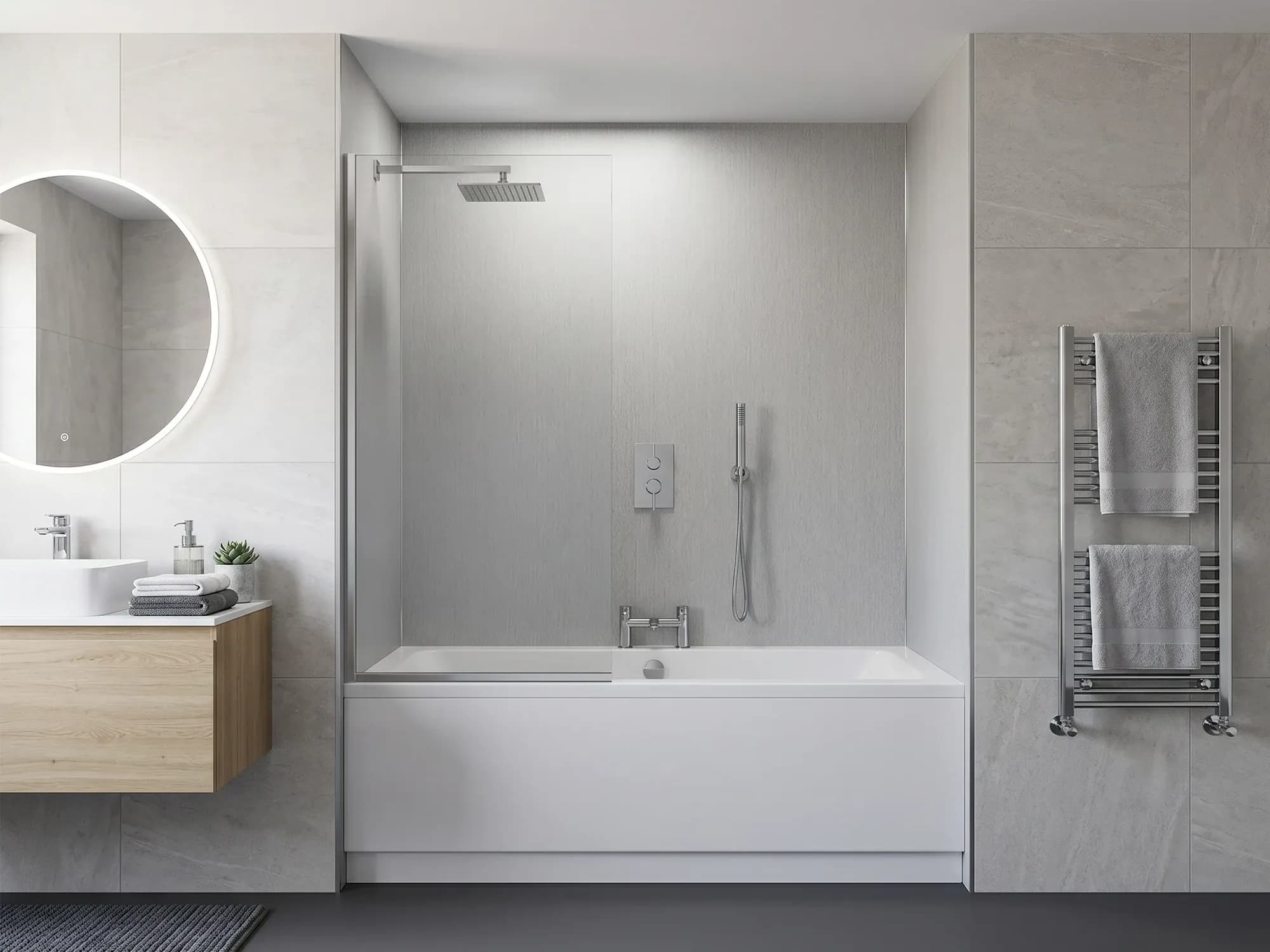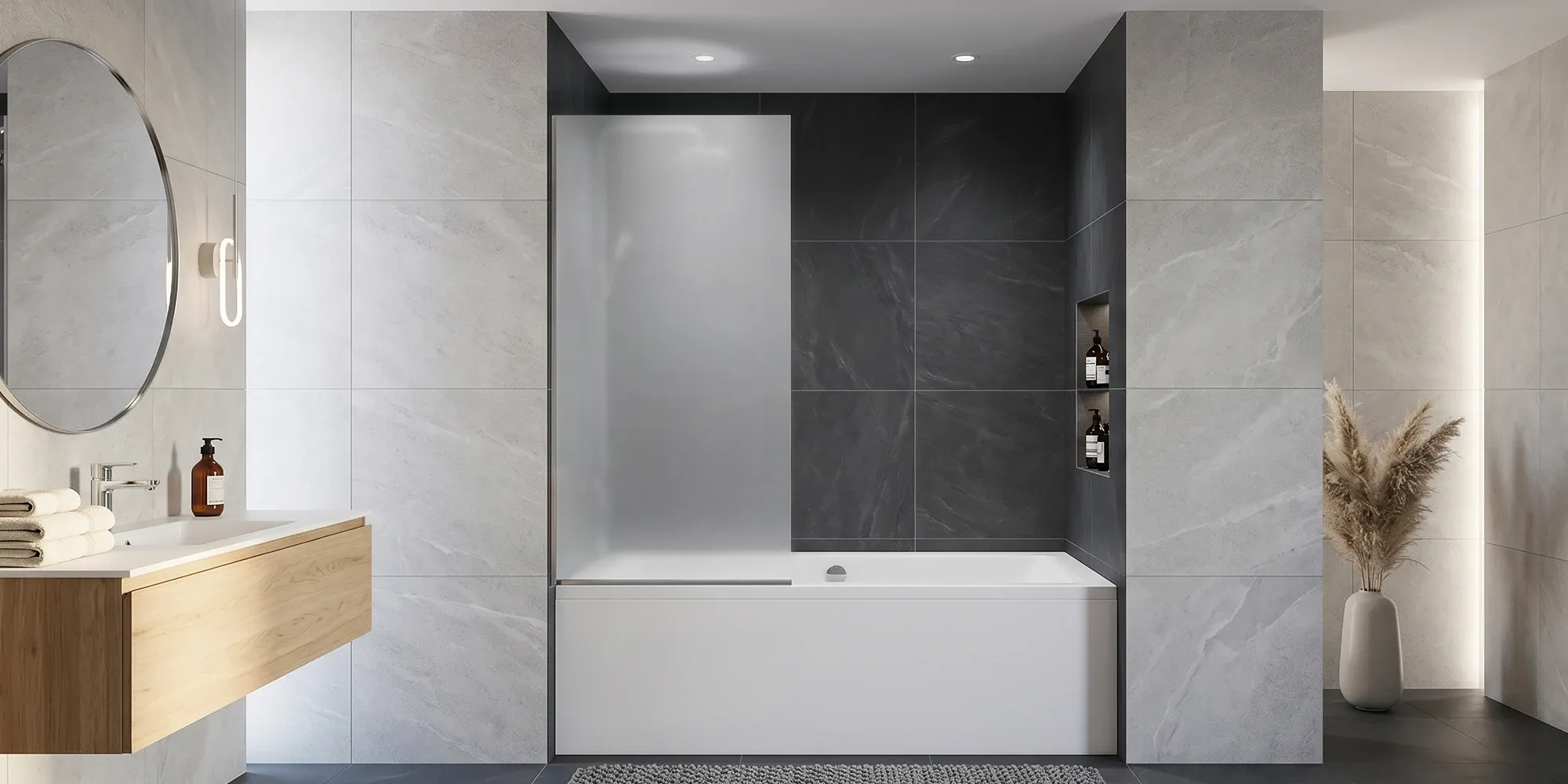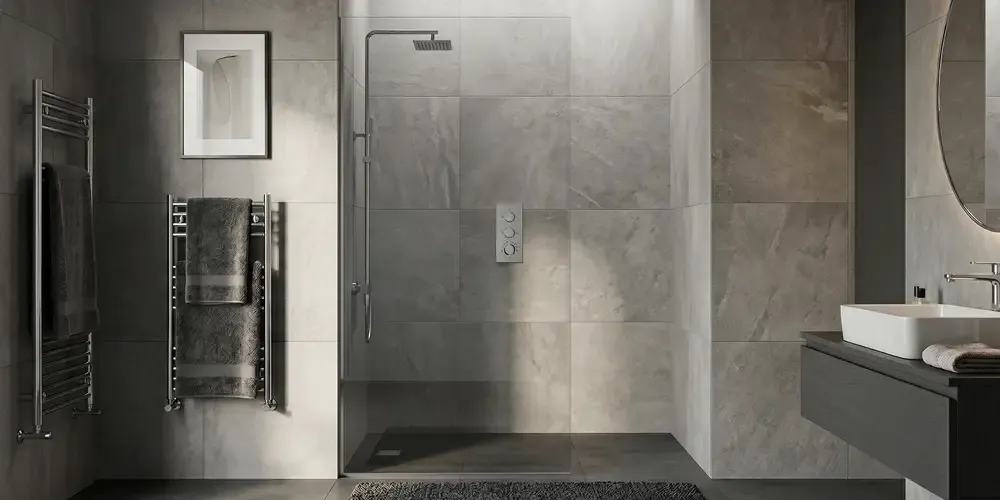
A fixed glass shower panel creates a walk-in shower with no door. A frameless hinged shower door encloses the opening with a swinging panel. Here's the full comparison: splash control, cost, cleaning, accessibility, and when each is the right call.
Reviewed by John Flouhouse, Installation Team Lead at Dulles Glass — based on custom shower measurements and installations.
When you're configuring a custom shower in a remodel, the first big choice is the door style: open walk-in with a fixed glass shower panel, or a fully enclosed shower with a hinged door. Both use frameless tempered glass, both look modern, but they solve different bathroom problems.
When we measure a custom shower, the right door style usually comes down to four things: opening width, shower head placement, nearby fixtures, and how much splash control the bathroom needs.
Key Takeaways
- Fixed glass shower panel: no door. Walk-in entry. Partial splash control. Cleanest visual look.
- Hinged shower door: swinging glass door. Better water containment when closed. Needs swing clearance.
- Fixed panels cost less at the same width because there's no door or hinge hardware.
- Hinged doors are often easier to fit in narrower shower openings, as long as there is enough outward swing clearance.
- Most custom installs combine a fixed panel with a hinged door for the best of both.
Best For: At a Glance
A quick summary of which shower option suits which bathroom before the full comparison below.
| Option | Best for / who it suits |
|---|---|
| Fixed glass shower panel | Best for larger walk-in showers where you want an open, minimalist look, easier accessibility for aging-in-place planning, and a lower-cost frameless option. Suits homeowners whose shower head points away from the entry. |
| Hinged shower door | Best for tighter bathrooms and layouts that need stronger splash control, full privacy, or heat and steam containment. Suits showers with rain heads, body sprays, or hand showers, and bathrooms where a walk-in opening is not practical. |
Quick Answer: Fixed Panel or Hinged Door?
Choose a fixed glass panel for walk-in showers in larger bathrooms where you want the open feel and easier accessibility. Choose a hinged shower door for limited floor space, layouts that need better water containment, or installations with rain heads, body sprays, or hand showers. For openings wider than 36 inches, the most common solution is a combination frameless shower layout that pairs a fixed panel with a hinged door.
What a Fixed Glass Shower Panel Offers
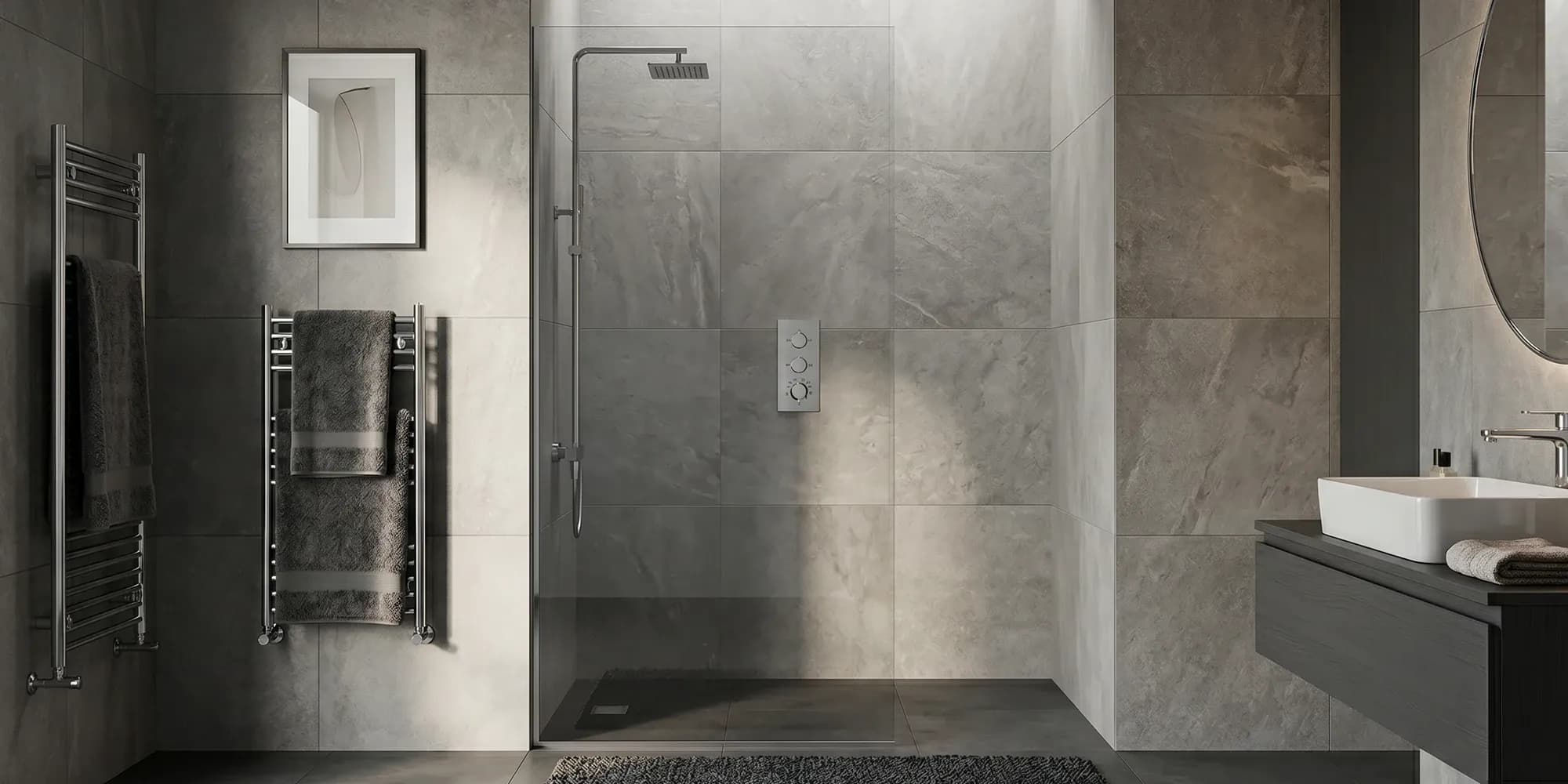
A fixed glass panel is a single piece of tempered glass anchored to the wall (and sometimes the floor or threshold), with no swinging door. It works as a walk-in shower glass panel — the remaining open section becomes the walk-in entry.
Strengths:
- Cleanest visual look in a bathroom — the most "open" of any configuration
- No door arc to plan around — works in layouts where a swing arc would hit a vanity or toilet
- Easier accessibility — no door to navigate around for aging-in-place planning
- Lower cost than a comparable hinged enclosure
- Easier to clean — no hinges, no seals, no track
- Shorter install timeline — no door hardware to fit
Limitations:
- Less splash control — the open section of the entry lets some spray escape if the layout isn't right
- No privacy on the open side
- Doesn't trap heat or steam
- Requires properly sloped pan — water drains toward the drain, not the open side
What a Hinged Shower Door Offers
A frameless hinged shower door is a single panel of glass attached by hinges to a stud-anchored wall plate. Unlike a fixed shower panel, it swings outward to open and closes against a magnetic strike on the opposite side.
Strengths:
- Full splash control when the door is closed
- Full privacy when closed (clear or frosted glass available)
- Traps heat and steam — useful in cold climates or for steam-shower installations
- Works on narrower openings where a walk-in isn't practical
- More familiar feel — most homeowners are used to a door
Limitations:
- Needs swing clearance — the door arc must clear any nearby fixture (toilet, vanity, opposite wall)
- Higher cost than a fixed panel at the same width
- More maintenance — hinges, seals, and sweep need replacement every few years
- Less accessible for users with mobility considerations
Side-by-Side: Fixed Glass Shower Panel vs. Hinged Shower Door
| Factor | Fixed glass panel | Hinged shower door |
|---|---|---|
| Visual feel | Open walk-in | Fully enclosed |
| Splash control | Partial — depends on layout | Better water containment when closed |
| Privacy | None on open side | Full when closed |
| Cost | Lower — no door hardware | Higher — hinges + door panel |
| Cleaning | Easiest — no hardware on glass | Hinges and seals need monthly attention |
| Accessibility | Walk-in — widest entry | Door must be opened first |
| Bathroom size | Best for larger bathrooms | Works in tighter bathrooms |
| Swing clearance needed | None | Door width plus nearby fixture clearance |
| Heat / steam control | No | Yes when closed |
Installer Tip
If the shower head points toward the opening, a fixed-only panel may allow more water onto the bathroom floor. In that case, we usually recommend changing the shower head angle, increasing panel coverage, or using a hinged door.
Cost: Fixed Glass Shower Panel vs. Hinged Shower Door
In general, fixed glass panels are usually the lower-cost frameless option, while hinged shower doors cost more because of hinges, handles, strike hardware, sweep alignment, and installation time. Exact pricing depends on size, glass thickness, finish, and site conditions.
A fixed panel usually costs less because it uses fewer moving parts: no hinges, no strike, no handle alignment, and no door sweep. The glass itself and the wall anchoring are the main cost drivers.
Final pricing still depends on glass thickness, panel size, hardware finish, notches, return panels, and installation conditions. A hinged door adds the door panel, hinges, and strike hardware on top of those, which is why it runs higher than a fixed panel at the same width. For a price specific to your shower, request an in-home measurement — the quote reflects the exact glass size, hardware, and site conditions.
Minimum Space Rules
Before choosing a style, check the layout against a few practical space rules:
- A fixed panel works best when the shower has enough depth for spray to land inside the shower area rather than reaching the open entry.
- A hinged door needs outward swing clearance equal to the door width, plus comfortable room around nearby fixtures so the door arc doesn't hit a vanity or toilet.
- For openings wider than 36 inches, a fixed-panel-and-door enclosure is often the most practical frameless layout.
When to Choose a Fixed Glass Shower Panel
The configurations where a fixed panel is the right call:
- Larger primary or master bathroom with room for a walk-in shower.
- Aging in place or mobility considerations — the open entry is more accessible.
- Modern, minimalist design preference — fixed panels offer the cleanest visual look.
- Properly positioned shower head — spray points away from the open side.
- Wet rooms or curbless showers where the bathroom handles some water.
- Budget priority on glass thickness or finish, not on enclosure.
When to Choose a Hinged Shower Door
The configurations where a hinged door is the right call:
- Limited floor space where a walk-in opening isn't practical.
- Better water containment needed — rain heads, body sprays, or hand showers.
- Cold-climate bathrooms where trapping warm air matters.
- Steam shower installations — the enclosure has to seal.
- Shared bathroom where full privacy when showering matters.
- Shower opposite a vanity within 4 feet — minimizes splash on the vanity.
Fixed Panel + Hinged Door: The Best of Both
The most common custom frameless configuration we install isn't fixed-only or hinged-only — it's a fixed glass panel paired with a swinging hinged door. The fixed panel handles the wider portion of the opening; the door fills the entry.
This combination works for:
- Walk-in showers wider than 36 inches
- Layouts where you want a clear visual entry plus better water containment
- Primary bathrooms with multiple shower heads or rain heads
- Corner installations where the panel runs along one wall and the door fills the corner entry
The fixed-plus-hinged combination is what many custom shower installs end up looking like — the open feel of a walk-in with stronger water containment than a fixed-only layout.
How Dulles Glass Helps You Choose
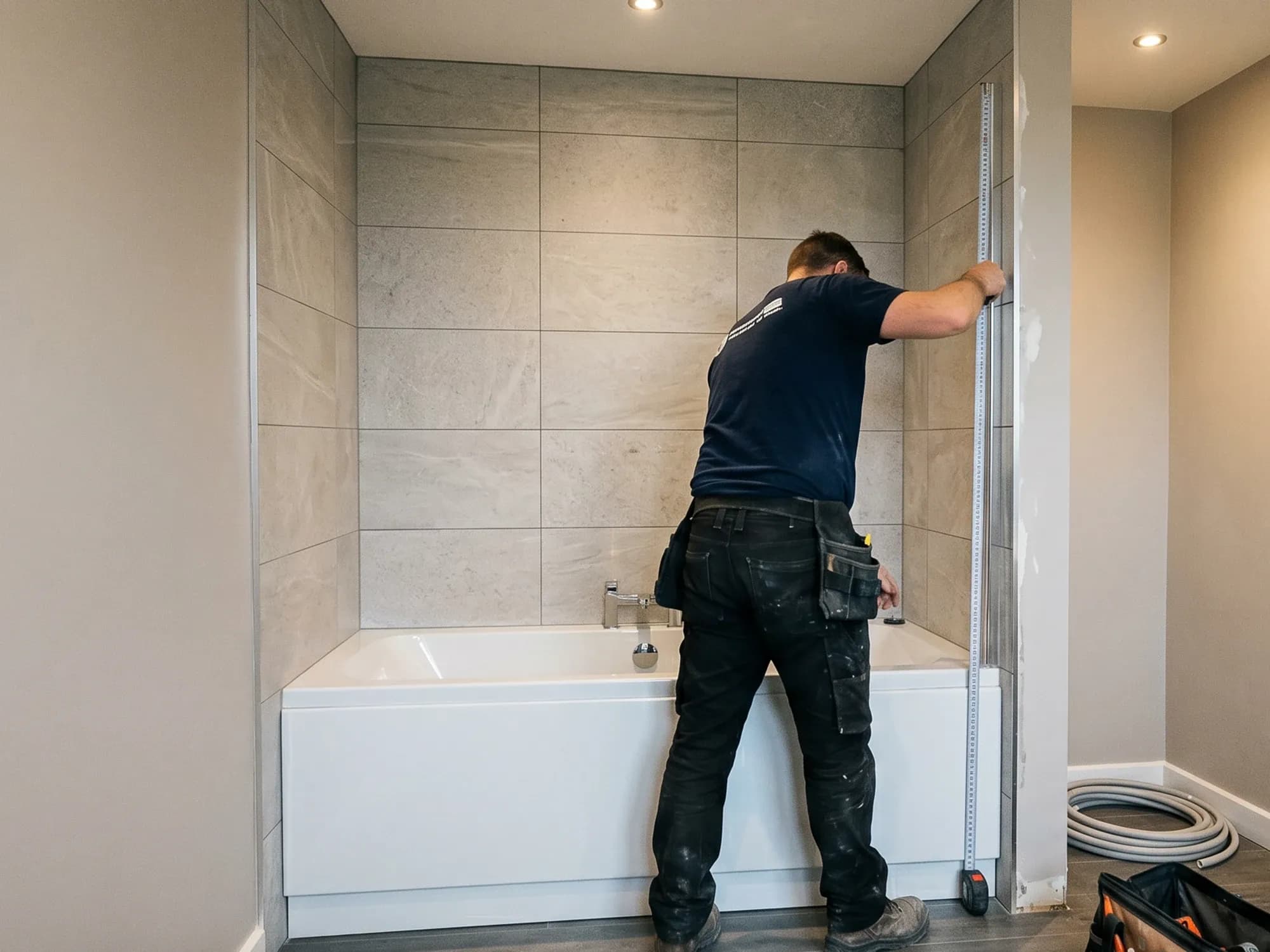
During measurement, our install team checks the opening width, wall support, threshold slope, shower head direction, and nearby fixtures. If a fixed panel will not control splash well enough, we may recommend a hinged door or a custom frameless enclosure that combines both instead. The goal is to match the glass configuration to the bathroom, not force one style into every space.
Exact recommendations depend on field measurements. Even two showers with the same opening width can need different glass layouts depending on threshold slope, wall plumb, shower head angle, and fixture placement.
Need Help Choosing Between Fixed and Hinged?
The right call depends on opening width, bathroom layout, shower head position, and how the rest of the bathroom is used. Dulles Glass fabricates and installs all three configurations — fixed panel, hinged door, and combination. We confirm the layout during the in-home measurement and recommend the right configuration.
We can also help you choose glass thickness, hardware finish, clear or low-iron glass, and privacy glass options based on the shower layout.
Compare our Tela shower screens, frameless shower doors, custom shower doors, and professional shower installation, or request a quote with your bathroom dimensions.
Frequently Asked Questions
What is the difference between a fixed glass shower panel and a hinged shower door?
A fixed glass shower panel is a single piece of tempered glass anchored to the wall with no swinging door, creating a walk-in shower. A hinged shower door has a swinging panel attached by hinges that opens outward. Fixed panels create a walk-in feel; hinged doors enclose the shower.
Which is better, a fixed shower panel or a hinged shower door?
Fixed panels are better for walk-in showers in larger bathrooms where you want the open feel and accessibility. Hinged doors are better for limited floor space, layouts that need better water containment, or showers with rain heads, body sprays, or hand showers. Neither is universally better; it depends on layout.
Does a fixed shower panel cost less than a hinged door?
Yes, usually. A fixed glass panel has no door, no hinges, and no strike hardware, so total cost is typically lower than a comparable hinged enclosure at the same width. Exact pricing depends on glass thickness, finish, and any return panel needed.
Can you have both a fixed panel and a hinged door?
Yes. The most common custom frameless configuration is a fixed glass panel paired with a swinging hinged door. The fixed panel handles the wider portion of the opening and the door fills the entry. This combination works for openings wider than 36 inches.
Is a fixed shower panel easier to clean than a hinged door?
Yes. With no hinges, no door swing, and no hardware on the open side, a fixed panel has fewer surfaces to clean. A hinged door requires monthly attention to the hinges, the strike seal, and the bottom sweep.
Does water splash out of a fixed shower panel?
It can if the panel is too short, the shower head points toward the opening, or the shower floor is not sloped correctly. A fixed panel works best when spray is directed away from the entry and the shower has enough depth to keep water inside.
Need help choosing between a fixed panel and a hinged door?
Dulles Glass fabricates and installs all three configurations. Send us your bathroom dimensions and we'll recommend the right configuration.
Why choose Dulles Glass
54+
Years Glass expertise
10,000+
Projects Measured and installed Yearly
3-Year Warranty
On custom installations
4.9/5 Rating
Customer Reviewed
Ready to start your glass project?
Tell us what you are planning and our glass experts will help you find the right solution.