Choosing between sliding, pivot, and hinged shower doors comes down to three things: opening width, bathroom layout, and how much clear space the door needs to operate. Here's a side-by-side comparison of the three frameless configurations, the real space requirements, and a decision framework for picking the one that fits.
Reviewed by John Flouhouse, Installation Team Lead at Dulles Glass
By the time a customer calls us about a shower door, they usually already know they want frameless. The question that stumps most people is the next one: sliding, pivot, or hinged?
It's a more consequential choice than it looks. The right configuration determines whether your bathroom feels spacious or cramped, whether the door hits your vanity every morning, and how much the whole project costs.
The Bottom Line
- Sliding shower doors: best for small bathrooms and wide openings (42–72") because they need no swing clearance.
- Pivot shower doors: best for larger, luxury layouts where there is clear space on both sides of the pivot axis. Needs at least 30" wide; 34"+ looks best.
- Hinged shower doors (also called swinging doors): best for most standard frameless enclosures, especially when paired with a fixed panel. Needs a clear swing path in front of the door.
- The biggest mistake: choosing a hinged door when the bathroom layout doesn't give it a clean opening arc.
Quick Decision
If your bathroom is tight → choose sliding.
If you want the cleanest custom frameless look → choose hinged with a fixed panel.
If you have a larger luxury opening with clear space on both sides → consider pivot (custom install only at Dulles Glass).
The three configurations, in plain language
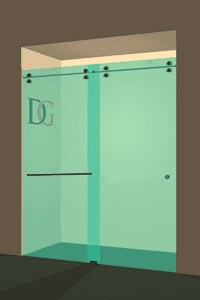
Configuration 1: Sliding (Bypass) Doors
Two glass panels that pass in front of each other on a top track. The door doesn't open into the bathroom.
Typical opening range: 42" to 72" wide.
Pros
- Zero swing clearance
- Ideal for tight bathrooms
- Works on wide openings
- Often most cost-effective for wide openings
Cons
- Opening is only half the width
- Bottom track can collect soap scum
- Roller mechanisms can wear over years
Configuration 2: Pivot Doors
A single glass panel that rotates on a top and bottom pivot point — opens both inward and outward.
Typical opening range: 30" to about 40" for the pivot panel.
Note: At Dulles Glass, pivot doors are custom-install only — not part of the DIY shower-door lineup. The precision required for the top-and-bottom pivot alignment is outside what a standard DIY kit accommodates.
Pros
- Full-width access
- Opens both in and out
- Most dramatic visual statement
- No bottom track
Cons
- Needs clear space both sides
- Typically most expensive
- Not suitable for small bathrooms
- Custom-install only at Dulles Glass (not a DIY product)
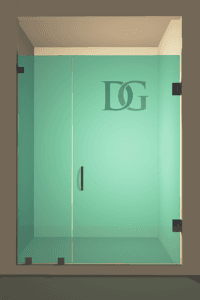
Configuration 3: Hinged Shower Doors
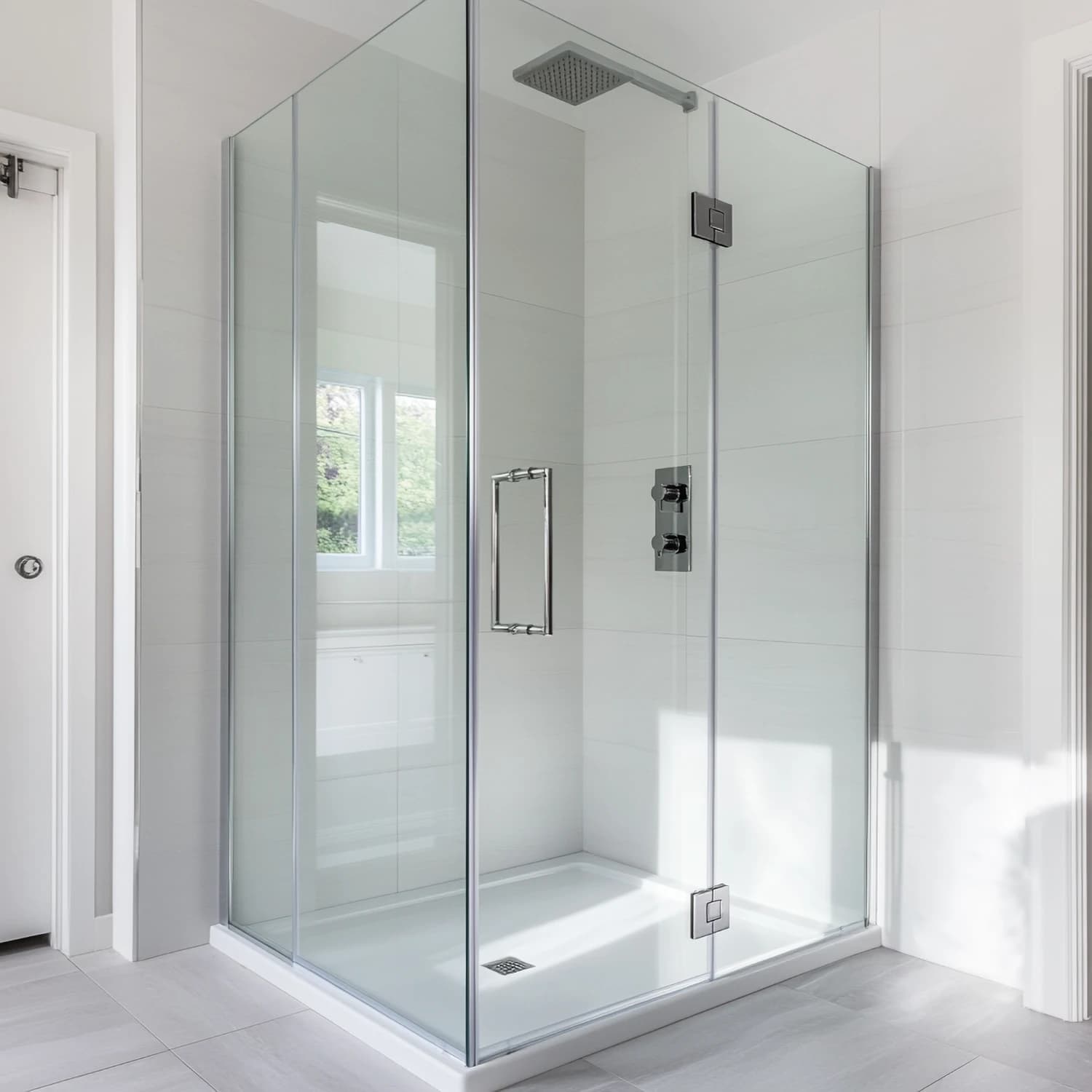
The most common frameless configuration. Glass panel held by hinges, swinging outward.
Typical opening range: 22" to 36" for the hinged panel; wider openings use a fixed panel.
Pros
- Classic frameless look
- Simpler hardware than pivot
- Most flexible with fixed-panel combinations
- Usually lower cost than pivot
Cons
- Requires clear swing arc
- Can hit toilets, vanities, or walls in tight layouts
- Heavier loads on hinge side
Side-by-side comparison
| Factor | Sliding | Pivot | Hinged |
|---|---|---|---|
| Best for | Small bathrooms, wide openings | Wide luxury openings, walk-ins | Most standard custom enclosures |
| Swing clearance | None | Both sides of pivot axis | Full outward arc |
| Opening width | 42–72" | 30–40" pivot panel | 22–36" hinged panel, +fixed |
| Cost | $$ — often most cost-effective for wide | $$$ — typically highest | $$ — standard for custom |
| Bottom track? | Usually yes | No | No |
| Glass thickness | 3/8" standard | 3/8" or 1/2" | 3/8" or 1/2" |
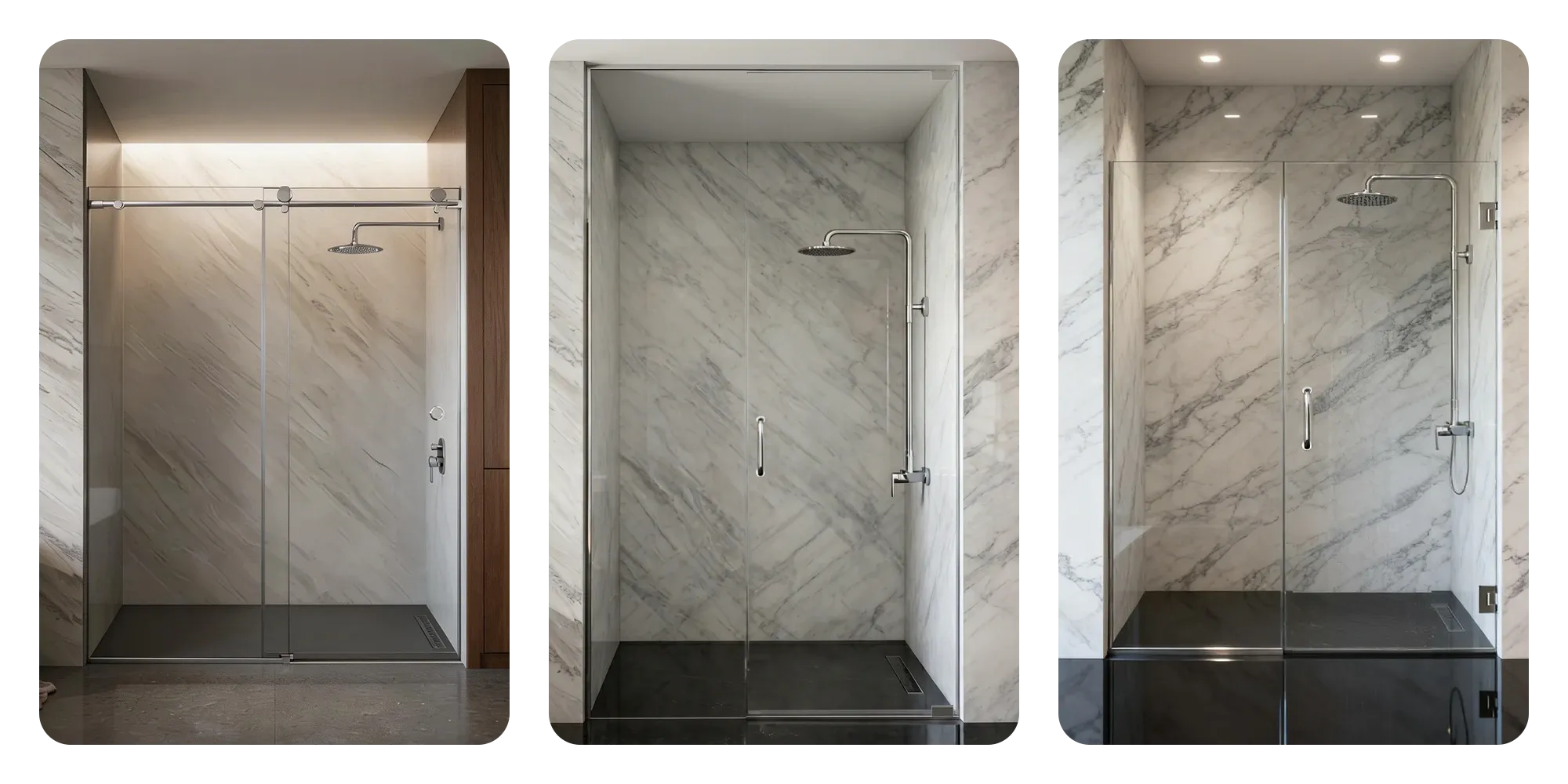
How sliding, pivot, and hinged doors compare on swing and clearance space.
The decision framework we use on the phone
- How wide is the opening? Under about 30", a single hinged door is often the practical choice. Over 42", sliding becomes viable. Over 60", look at a slider or hinged+fixed-panel combination.
- What's across from the shower? Toilet 24" away, vanity that sticks out, narrow hallway — all rule out a hinged door. Slider works regardless.
- What's the style goal? "Dramatic luxury" = pivot. "Looks nice, reasonable cost" = hinged door with a fixed panel.
Most customers who think they want a single hinged door end up with a hinged-door-plus-fixed-panel configuration. The fixed panel handles the width and the hinged door just provides the entry.
Not sure which configuration fits your bathroom?
Request a quote or schedule an in-home measurement in the Mid-Atlantic. Our team will confirm the best shower door layout before fabrication begins.
Explore our frameless shower doors, sliding shower doors, and custom glass shower enclosure options, or request a quote to confirm the right configuration for your bathroom.
When to avoid each configuration
Avoid sliding if...
- Opening under 42" — half-width access becomes awkward
- You want a fully-open entry
- You don't want a bottom track to clean
Avoid pivot if...
- The bathroom is tight — any fixture within the swing arc is a problem
- You're on a tight budget — pivot is typically the most expensive
Avoid hinged doors if...
- The door would hit a toilet, vanity, or opposing wall
- The hinged panel would exceed about 36" — too heavy for safe long-term use
During an in-home measurement, our team confirms the opening width, wall conditions, and swing clearance before fabrication. That on-site step is what turns a configuration choice into a door that actually fits the bathroom.
What about semi-framed?
We offer one semi-framed option: a double slider with a semi-framed structure along the top and bottom. It's specifically useful for wide openings where fully frameless sliders become expensive or where the customer wants extra structure around the glass for peace of mind.
Configuration options: custom shops vs big-box vs online
Big-box stores like Home Depot and Lowe's primarily sell premade sliding doors in standard sizes (typically 60" bypass sliders for tub-shower combos). Pivot and custom hinged configurations are rarely available off the shelf — those are almost always custom fabrication.
Online competitors like Fab Glass and Mirror offer configuration options through their websites, but many online ordering experiences require homeowners to enter exact measurements and configuration choices before ordering, which can be difficult if the opening is out of square or the layout has clearance issues. A wrong configuration choice can mean delays, return costs, or reordering glass.
Our approach: we walk through the three-question decision framework on the phone before you commit, then confirm it during the in-home measurement. The right configuration is locked in before fabrication starts.
What we hear from customers
Here is a representative moment from recent Dulles Glass customer calls that shows how the configuration decision usually plays out:
"I was looking very specific to the sliding — I don't want swing, it's a very small bathroom."
Customer discussing door configuration for a small bathroom — from recent Dulles Glass customer calls
In recent calls, customers often ask how configuration affects price. Our team explains that the final cost depends on opening size, glass thickness, hardware, and whether the layout requires sliding, pivot, or hinged glass.
Frequently asked questions
What is the difference between pivot and hinged shower doors?
A pivot shower door rotates on top-and-bottom pivot hardware and can often open inward and outward. A hinged shower door is mounted from the side and typically swings outward, often paired with a fixed glass panel for wider openings.
Can a sliding shower door be fully frameless?
Yes. Fully frameless sliders use a top track with a minimal profile, no visible side frames, and no vertical metal.
Do pivot doors leak more than hinged doors?
Not inherently. Both rely on proper glass-to-threshold clearance and good weatherseal placement. Leaks are almost always an installation issue.
Which configuration is cheapest?
It depends on opening size. For narrow openings (under ~36"), a hinged door is usually most cost-effective. For wide openings (42"+), sliding is often cheaper. Pivot is usually the most expensive.
Can I convert one type to another later?
Technically yes — but rarely practical. Converting usually means new glass, new hardware, and sometimes new wall anchors. The cost is close to the original install.
What's the maximum size for a hinged shower door panel?
We cap the hinged panel around 36" wide in 3/8" tempered glass. Wider openings use a fixed panel with a smaller hinged section for entry.
Sources & Standards Referenced
- ANSI Z97.1 — American National Standard for Safety Glazing Materials
- 16 CFR Part 1201 — U.S. CPSC Safety Standard for Architectural Glazing
- Industry standard residential opening ranges for sliding, pivot, and hinged frameless shower enclosures
- Dulles Glass installation experience and common questions from customers
In-Home Measurement
We'll look at your opening, the surrounding fixtures, and recommend the configuration that fits your bathroom.
Why choose Dulles Glass
54+
Years Glass expertise
10,000+
Projects Measured and installed Yearly
3-Year Warranty
On custom installations
4.9/5 Rating
Customer Reviewed
Ready to start your glass project?
Tell us what you are planning and our glass experts will help you find the right solution.