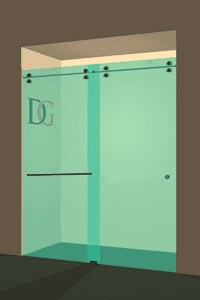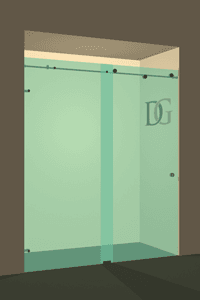
Shopping for sliding glass shower doors? Most models you'll see are bypass doors — but the biggest surprise is that the walk-through opening is only half the total door width. Here's how bypass shower doors work, what sizes they fit, and how to tell if they're right for your bathroom.
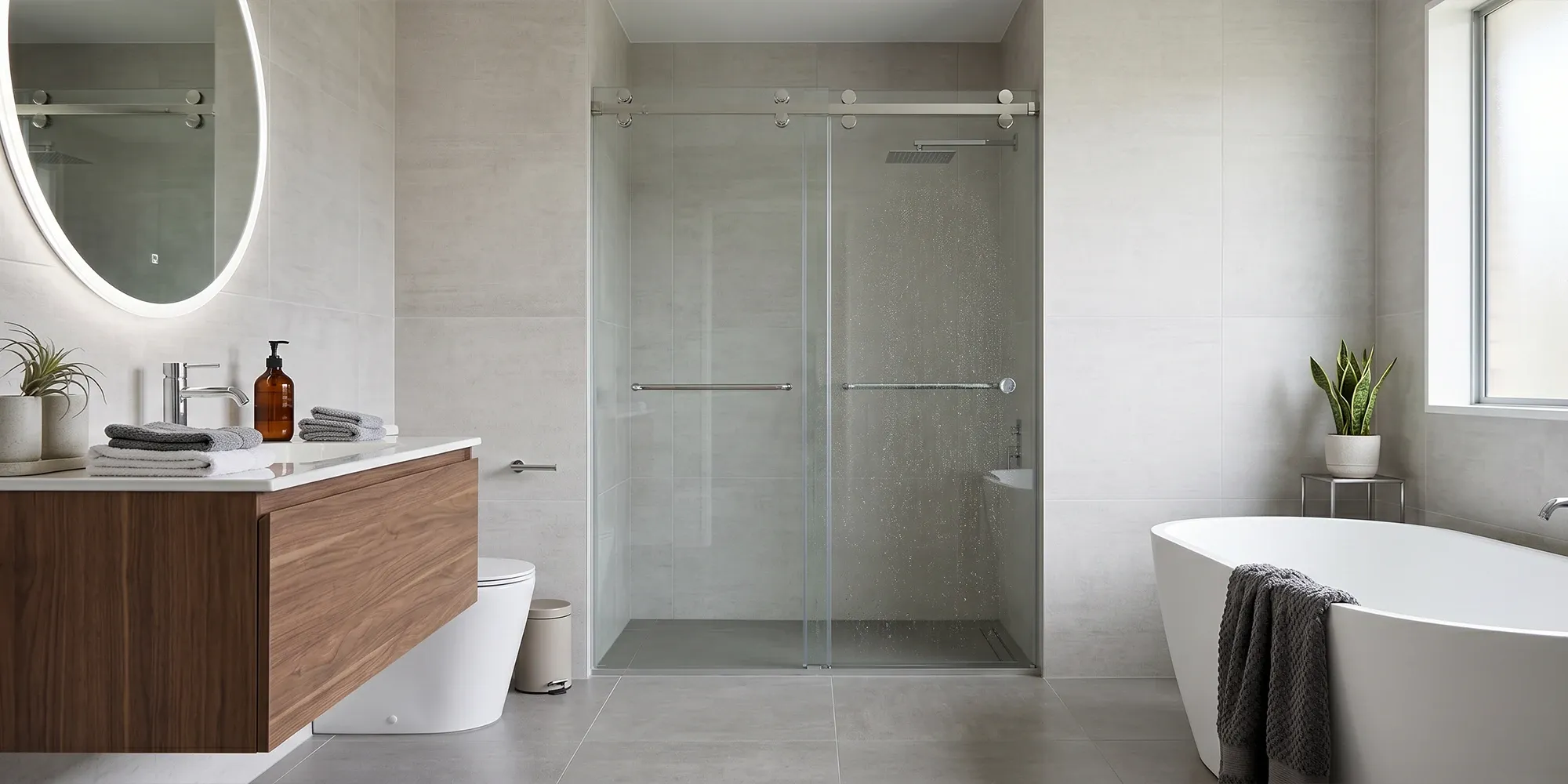
Reviewed by John Flouhouse, Installation Team Lead at Dulles Glass, based on field measurements and installations.
Quick Answer
Choose a bypass shower door if your bathroom is tight, your opening is 42–72 inches, and you do not want swing clearance. Most frameless bypass shower doors sold today fit standard alcoves and tub-to-shower conversions in this range.
Skip bypass if you need a wider walk-through, your opening is under 42 inches, or the design you're considering uses a deep bottom track that's hard to clean.
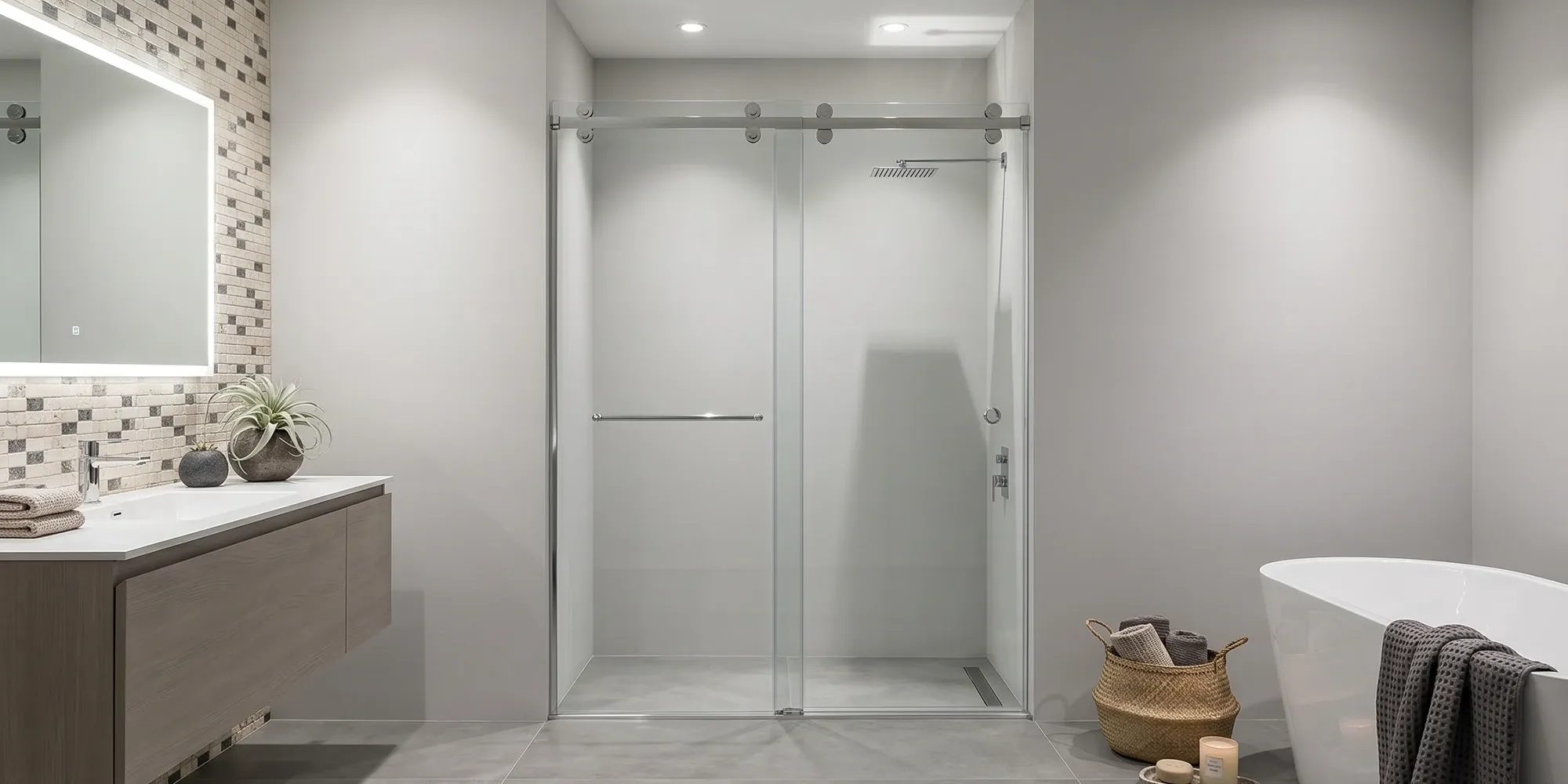
Most sliding shower doors people picture in their head are actually bypass sliding shower doors — two glass panels that overlap and slide past each other on a top track. They're one of the most common sliding glass shower doors sold in the US, partly because they work on a wide range of openings and partly because they're often one of the most cost-effective ways to enclose a wider shower with no swing clearance needed.
If you're shopping for a sliding glass shower door, almost everything labeled "sliding shower door" at a big-box store is a bypass. Understanding what that means — and where it's the right call versus single-sliders or hinged shower doors — is the difference between a door you live happily with and one you wish you'd configured differently.
The Bottom Line
- Bypass = two-panel sliding. Two pieces of glass overlap and pass each other on a top track. Opening is half the door width.
- Best opening range: 42" to 72" wide. Below 42" the entry feels cramped; above 72" you usually want a 3-panel slider or a slider + fixed-panel combo.
- Top track is structural; bottom track is optional. Modern frameless bypass sliders use a bottom guide channel, not a heavy bottom track — easier to clean than older framed slider designs.
- Equal panels (50/50) are the default. Unequal panels (60/40 or 70/30) are available where one wall is longer than the other.
- Pick bypass when: the bathroom is tight, the opening is wide, or you don't want a door swinging into the room.
What "bypass" actually means
In sliding-door terminology, bypass means the two panels move past each other rather than telescoping into a single stack or operating independently. One panel runs on the front track; the other runs on the rear track. To open the shower, you slide one panel sideways and it disappears behind the other.
This is different from:
- Single sliding door — one glass panel that slides past a fixed panel. Less common in residential; sometimes seen in barn-door style configurations.
- Telescoping — multiple panels that stack into one space when opened. Used on commercial showers and very wide openings (8 ft+).
- Bi-fold — two hinged panels that fold flat against one side. Rare in showers, more common in closet doors.
Bypass shower door sizes and panel ratios
Most bypass shower door sizes fall in a specific opening range. The minimum is set by the half-width access (a 42" opening gives you a 21" usable entry, which is the floor of what most adults find comfortable). The maximum is set by glass weight — a single panel wider than 36" in 3/8" tempered glass starts pushing the roller hardware limits.
| Opening | Typical panel layout | Best for |
|---|---|---|
| 42-48" | Equal 50/50 panels (~24" each) | Standard guest baths, tub/shower combos |
| 48-60" | Equal 50/50 panels (~30" each) | Primary bath alcoves, larger showers |
| 60-72" | Equal 50/50 (~36" each) or unequal 60/40 if one side is longer | Walk-in showers, primary suites |
| 72"+ | Often switches to slider + fixed panel, or 3-panel telescoping | Large walk-ins, custom showers |
Quick Math
For a fast estimate, divide your total opening width by two — that's roughly your walk-through space. A 60" bypass door gives you a 30" entry; a 48" door gives you 24". For a full measuring walkthrough, see our shower door measuring guide.
The Half-Width Rule
The single most common surprise on bypass sliders: the opening you walk through is exactly half the door width. A 60-inch sliding door gives you a 30-inch entry, not 60. If you want a wider entry, bypass isn't the right configuration — look at a single-slider plus fixed panel, or a hinged door if the opening fits.
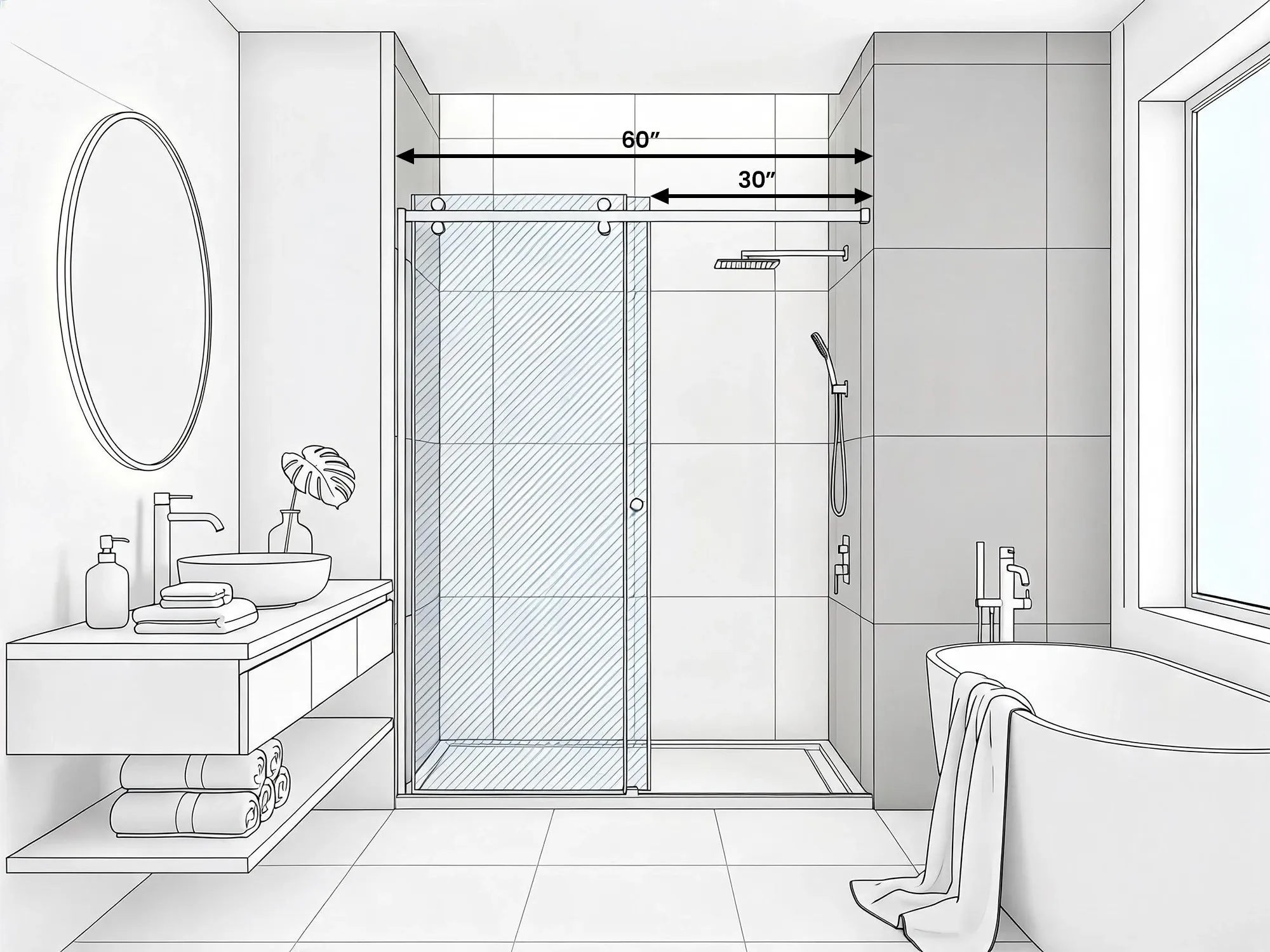
Measurement diagram: a 60-inch bypass shower door provides a 30-inch walk-through opening because one panel always overlaps the other.
Top track vs bottom track
The track system is where the biggest engineering differences between cheap and quality bypass sliders show up.
Top track (the structural one)
The top track carries the full weight of both panels through a roller system. On modern frameless sliders this is a clean horizontal extrusion anchored into wall blocking at both ends. Quality rollers run on stainless or solid-brass bearings and stay smooth for decades; lower-grade roller hardware may wear faster or begin to drag over time.
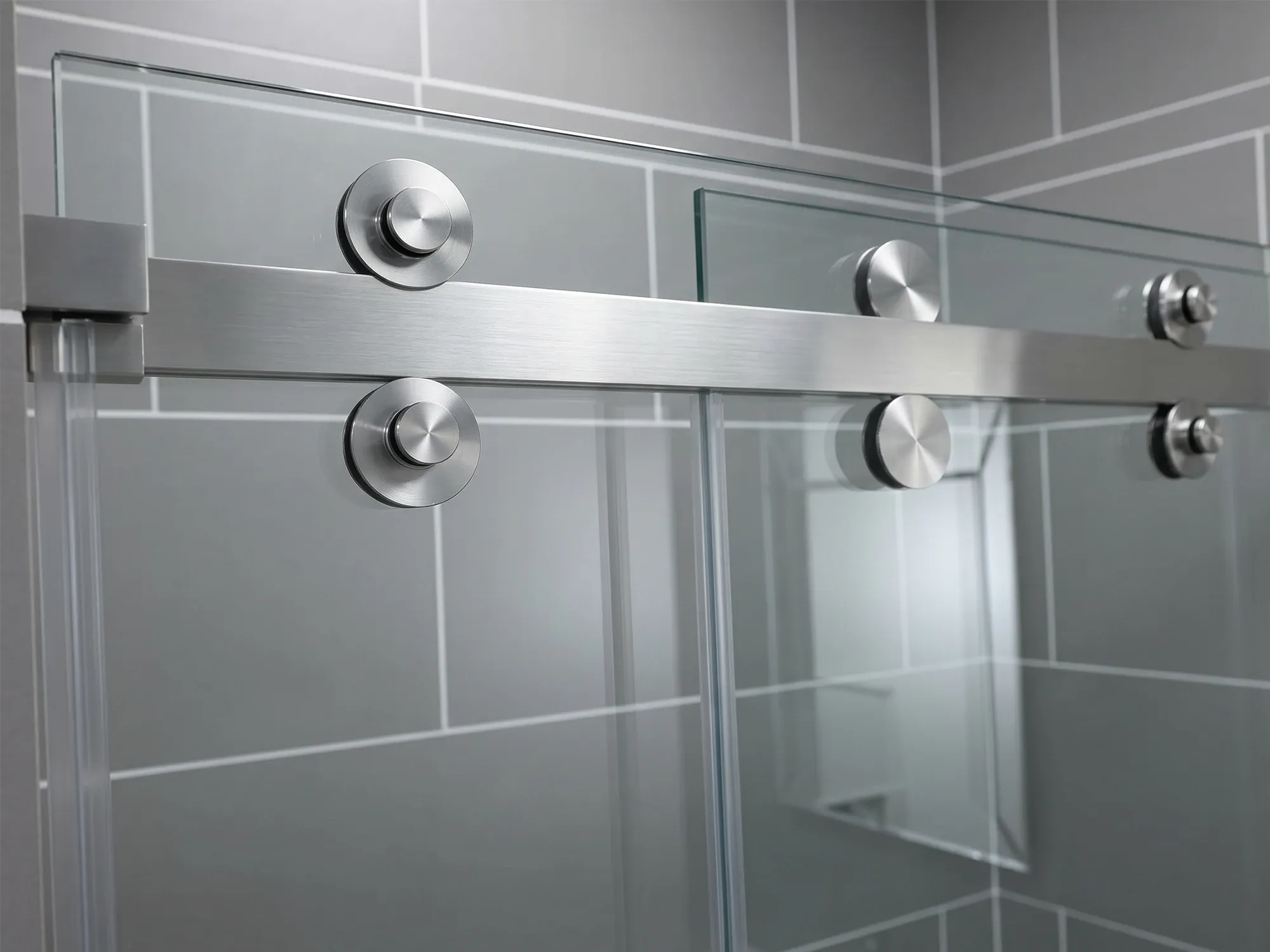
Close-up of a top roller assembly on a frameless bypass slider, showing the stainless bearing wheel and the mounting bracket capped over the drilled glass panel.
Bottom track or guide channel
Older framed sliders had a full bottom track — a deep channel that ran the width of the opening. It collected soap scum, mildew, and was the most-hated thing to clean in the bathroom.
Modern frameless bypass sliders use a minimal bottom guide channel instead — just enough to keep the panels from swinging, typically a small fin or roller pin that engages a shallow groove on the threshold. Easier to clean; less visual weight; same stability.
If you see a deep bottom track on a slider you're shopping
That's a framed or semi-framed design — not a frameless bypass. The bottom track will be a maintenance pain point. Frameless bypass sliders should have either no bottom track or a barely-visible guide channel.
Bypass vs the alternatives
The most common comparison shoppers run is bypass shower doors vs hinged shower doors — and the deciding factor is almost always swing clearance. Here's how bypass stacks up against the hinged door and the other alternatives:
| Configuration | Best for | Trade-off |
|---|---|---|
| Bypass slider | Tight bathrooms, wider openings, no swing clearance | Half-width entry |
| Single slider + fixed panel | Wider entry needed but still no swing | Costs more, needs more wall space for the fixed panel |
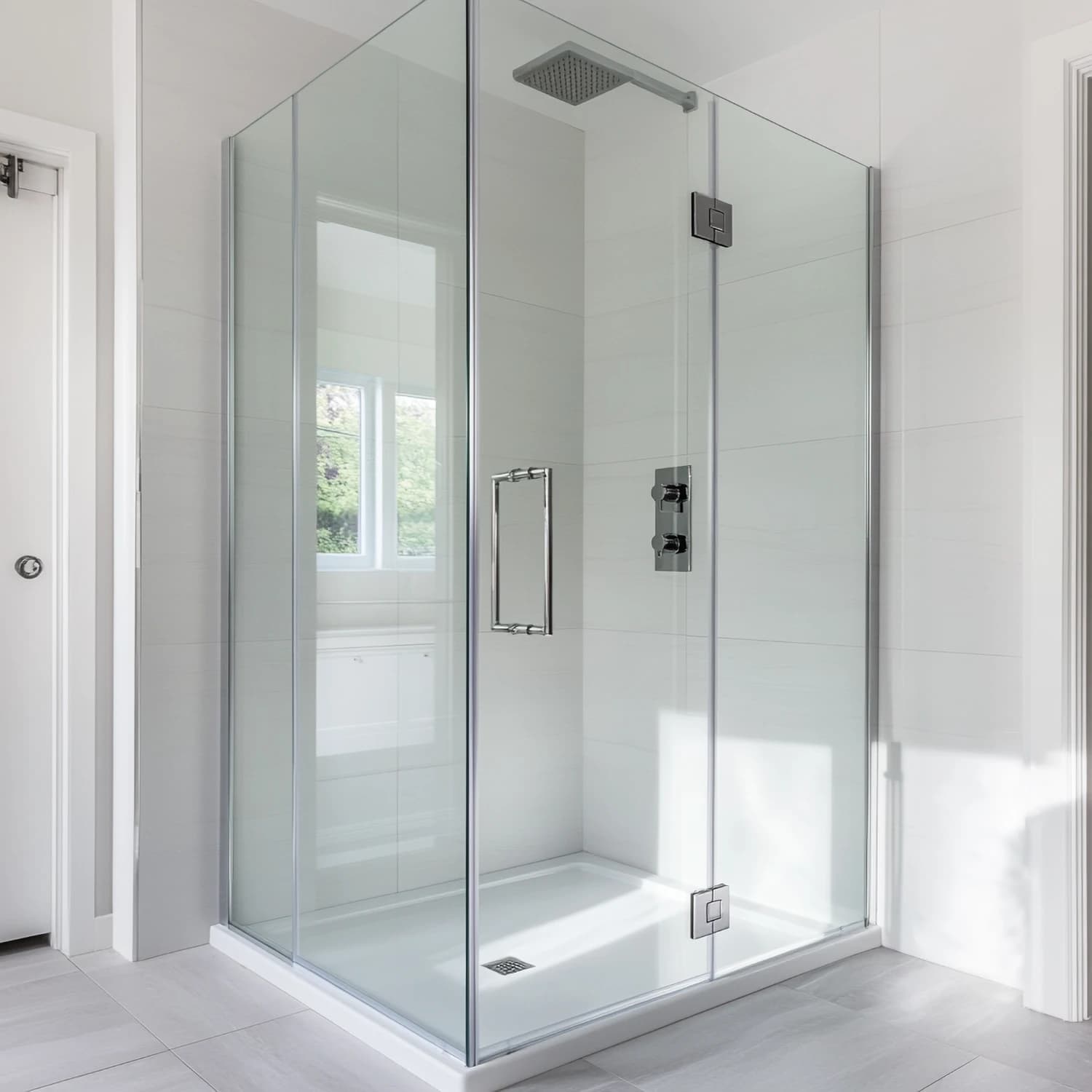
| Hinged (swinging) door | Standard custom enclosures with clear swing arc | Needs swing clearance; door hits toilets/vanities in tight layouts |
| Pivot door | Wide luxury openings, walk-ins | Custom-install only; expensive; not a DIY product at Dulles Glass |
For many tight bathrooms or openings wider than 42 inches, bypass is one of the most practical options. The half-width entry is a real trade-off, but it's the cost of not giving up floor space for swing clearance.
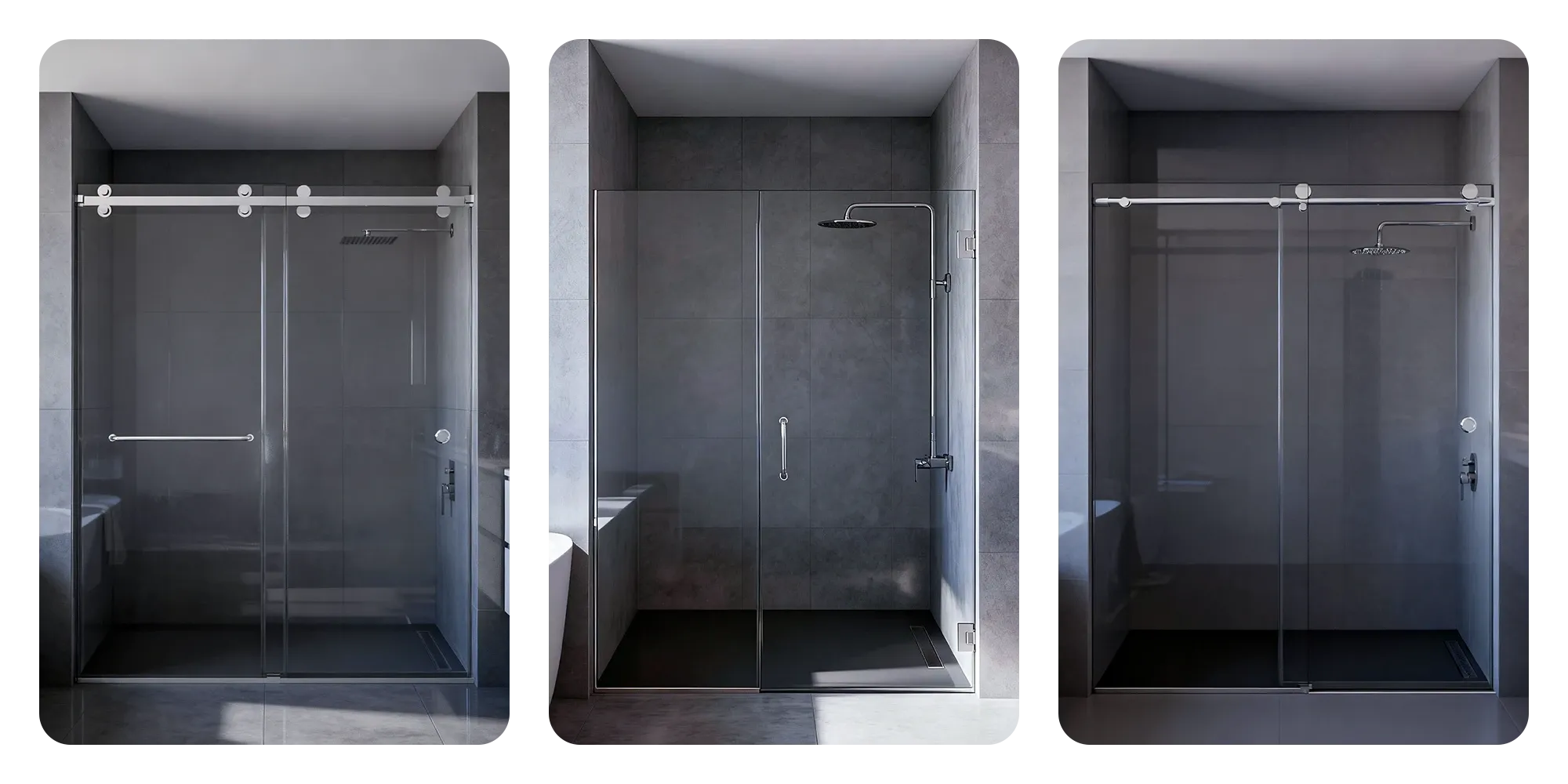
Comparison diagram: bypass slider (two panels overlapping on top track) vs hinged door (single panel swinging outward) vs single-slider plus fixed panel.
Is a bypass shower door right for your bathroom?
Here's a quick checklist to figure out whether bypass is the configuration you should be ordering:
Bypass is probably right if
- Your bathroom is tight and a swinging door arc would hit something (toilet, vanity, opposite wall)
- Your opening is between 42 and 72 inches wide
- You want to avoid taking up floor space with a swing arc
- You're comfortable with a walk-through opening narrower than the total door width
- You like the look of two glass panels overlapping over a single hinged door
Bypass is probably not right if
- You want a wider walk-through entry — consider a single slider with fixed panel, or a hinged door if you have the swing clearance
- Your opening is under 42 inches — the half-width access becomes too narrow
- You hate cleaning bottom tracks — double-check the design you're considering uses a minimal bottom guide, not a deep track
- Your opening is wider than 72 inches — ask about a 3-panel telescoping design or a slider-plus-fixed-panel configuration instead
Frameless bypass shower doors at Dulles Glass
Several models in the Dulles Glass DIY frameless bypass shower door lineup are configured specifically for the bypass pattern. Here's how to pick the right one for your bathroom:
Premium — 3/8" Frameless
Metro · Sero
The heavier frameless look in 3/8" tempered glass with premium roller hardware. More rigid panels, more substantial visual weight, longer-lasting hardware spec.
Best for: primary bathrooms · remodels for resale
Semi-Frameless — 3/8"
Eclipse
A 3/8" semi-frameless option — the structural channel handles wider openings cleanly and gives you a frameless-style look at a softer price point.
Best for: wider openings · mid-tier budgets
Value — 1/4" Frameless
Mona · Vera · Luna
Lighter 1/4" tempered glass frameless designs at the value price point. Same frameless silhouette in a budget-friendly tier. Mona uniquely offers both 3/8" and 1/4" thicknesses if you want to choose between feels in one model line.
Best for: guest baths · budget-led upgrades · rentals
Custom-install bypass sliders are also available for non-standard openings (under 42" or over 72", or where the wall plumb is outside DIY tolerances) — request a custom quote with your measurements.
Not sure which bypass model fits your bathroom?
Browse the full DIY bypass lineup by opening size, or send us your measurements and we'll recommend the right model line and finish.
Common bypass-slider mistakes
Avoid these on a bypass slider shopping trip
- Underestimating the half-width entry. Stand in your bathroom and measure half your opening with your hands. That's your real walk-through width.
- Choosing a deep-bottom-track design in a low-effort cleaning household. The track will be the worst part to clean.
- Forgetting about left/right handing. Bypass sliders have a designated "front" panel — the one that overlaps the back panel on the entry side. Make sure the front panel is on the side you actually want to use as the entry.
- Skipping the roller spec. If the spec sheet doesn't list roller material or weight rating, ask the seller to confirm before buying — solid-brass or stainless rollers typically last decades, while lower-grade alternatives may wear sooner on a heavier 3/8" glass door.
- Skipping the dry-fit on DIY. Modern bypass slider kits have just enough tolerance that a dry-fit catches plumb issues before you commit to drilling. Always dry-fit first.
Frequently asked questions
What's the difference between bypass and single sliding shower doors?
Bypass uses two panels that pass each other on a track — the most common slider configuration. Single sliding uses one panel that passes a fixed panel. Bypass is more common in residential because it works on a wider range of opening sizes; single sliding is more common in walk-in shower configurations where you want a wider entry.
How wide an opening do I need for a bypass slider?
Bypass sliders work best in 42-inch to 72-inch openings. Below 42 inches the half-width entry feels too tight. Above 72 inches you usually want a slider + fixed panel combination or a 3-panel telescoping design instead.
Are bypass sliding doors hard to clean?
Modern frameless bypass sliders are easier to clean than the older framed designs. The deep bottom track that used to collect soap scum has been replaced by a minimal guide channel — or eliminated entirely in some designs. Daily squeegee + weekly pH-neutral wipe is the routine.
Can I get a bypass slider in 1/4-inch glass?
Yes — 1/4-inch bypass sliders are common in the value price tier (Vera, Luna at Dulles Glass; many big-box options). 3/8-inch is premium: heavier, more rigid, more substantial visual weight, longer-lasting roller hardware spec. The price difference is usually $200–$500 at the DIY level.
Do bypass sliders leak?
Properly installed, no. The vertical seal where the two panels overlap, plus the wall-side seal at the strike jamb, contain the water spray. Leaks on bypass sliders are almost always a damaged seal, a misaligned roller, or a missing silicone bead at the wall mount — all field-fixable.
Which roller hardware lasts longest?
Solid brass or 316 stainless steel rollers with sealed bearings. Zinc-alloy rollers with plastic bushings are common on imported and big-box sliders — they're fine when new but start to drag within 5–10 years. If the spec sheet doesn't list roller material, ask the seller to confirm before buying.
References
- ANSI Z97.1 / 16 CFR Part 1201 — Architectural safety glazing standards
- Dulles Glass DIY catalog and installation specs for bypass slider models (Metro, Eclipse, Sero, Mona, Vera, Luna)
- Field-team service notes on bypass slider failure patterns, 2018-2026
Shopping for a bypass sliding shower door?
The Dulles Glass DIY bypass slider lineup ships nationwide with 3/8" or 1/4" tempered glass and quality roller hardware matched to each panel weight. Compare Metro, Eclipse, Sero, Mona, Vera, and Luna by opening size and price.
Why choose Dulles Glass
54+
Years Glass expertise
10,000+
Projects Measured and installed Yearly
3-Year Warranty
On custom installations
4.9/5 Rating
Customer Reviewed
Ready to start your glass project?
Tell us what you are planning and our glass experts will help you find the right solution.